
Welcome to Homes for the Holidays!
The Landmark Trust is honored to continue our traditional Historic Holiday Tour. Thank you for joining us. Click the name of each site to read a description of the property and its history.
Smallhouse-Mansfield-Sciuto House
530 East 13th Ave
Boxwood
1234 State St
State Street United Methodist Church
1101 State St
Kister House-Eloise B. Houchens Center
1115 Adams St
Lindsey House
516 Chestnut St
George Washington Carver Center
201 State St
Smallhouse-Mansfield-Sciuto House
The first stop on this year’s Historic Holiday Tour is the Smallhouse-Mansfield-Sciuto House at 530 East 13th Avenue, built circa 1885.
The first recorded deed to this property put it in the Wooten family, who through a series of transactions and names eventually sold it to C.G. Smallhouse—President of Warren Deposit Bank. It appears Smallhouse then gifted the lot to his daughter, Clara, who married William Mansfield, in 1885.
From that date, the Mansfields built this beautiful Victorian house at the corner of 13th and Chestnut. But they did not live there for long—rather, they sold the house back to the Smallhouses, who moved in and resided there for many years.
Although not large, this beautiful house is notable for several reasons. The interior is essentially intact in its original form but well-adapted to modern needs. Remarkably, the exterior retains its original cornice, corbels, windows, and shutters. Well-preserved for 140 years, the property is now entering a new chapter with the Sciuto family, who are graciously sharing their “home for the holidays.”
Boxwood
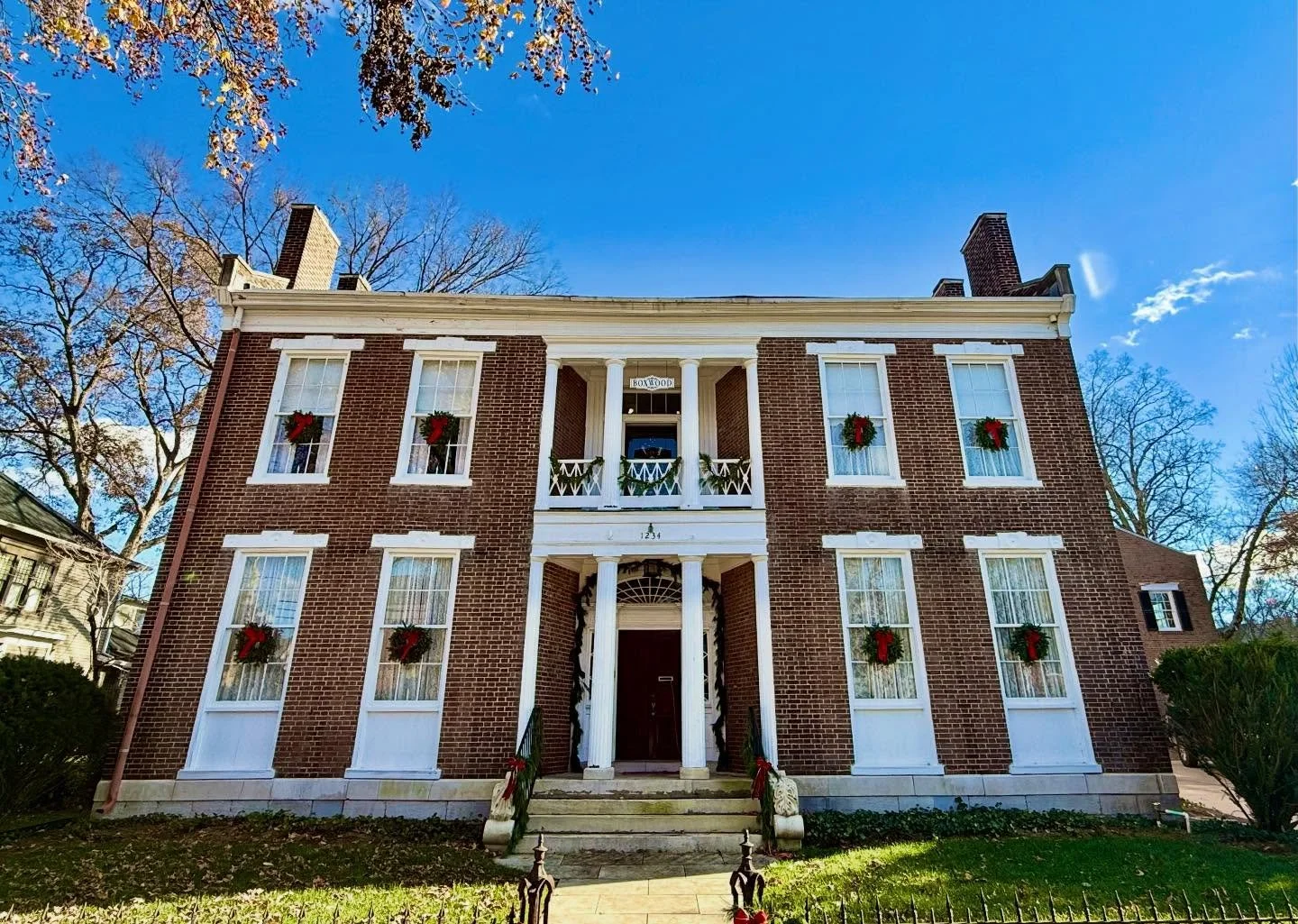
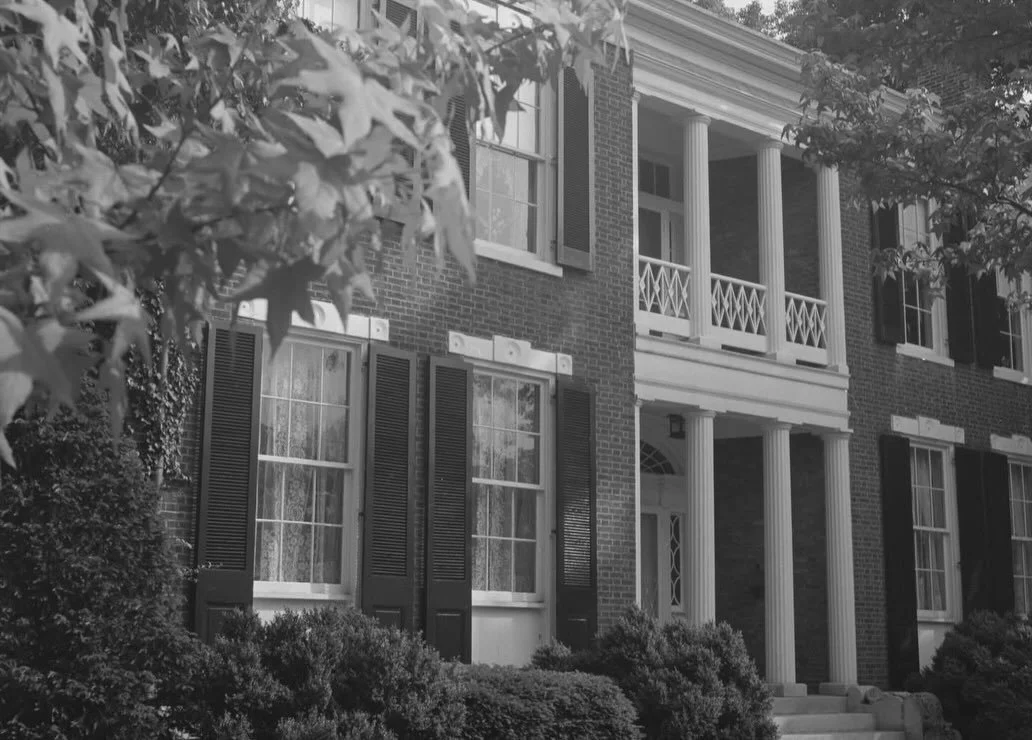
The second stop on this year’s Historic Holiday Tour is perhaps the best known and certainly the oldest on tour. Indeed, historic Boxwood, located at 1234 State Street, was originally finished in 1843 and expanded circa 1930.
The house is worthy of its nickname—“The House of Dignity.” To wit, it is an architectural masterpiece not just of the antebellum period but also of later times—a superb example of adaptive reuse by a succession of prominent and interesting owners.
The original building was a single-pile brick structure with a wooden ell completed and possibly designed by JB Clark—although architect Hugh Roland (1792-1852), working in the region at the time, is a distinct possibility.
Unique and fine original architectural features include the Flemish bond brickwork, complex cornices and carved stone elements, and unusual loggia-style (recessed) portico. The Doric Order and proportion is employed throughout the building. Jib windows, now encased, are likely original.
By 1930, Boxwood’s original grandeur was beginning to fade. This was remedied by the OV Clark family, who expanded the house and walled the garden in consultation with architect James Maurice Ingram and landscape architect Ruth Rabold. The original wooden ell was demolished and a new brick expansion completed, seamlessly melding the best craftsmanship of the nineteenth and twentieth centuries. Party goers of the “Clark Two” era affectionately called Boxwood “the White House, South.”
Historic Boxwood was purchased by Ellen and Eric Aldridge in 2024. It is now entering a new chapter of investment and restoration—receiving both our Jean Thomason and Ruth Rabold awards earlier this year. Please join us in thanking the gracious Aldridges for sharing their “home for the holidays” with us and the entire community.
State Street United Methodist Church
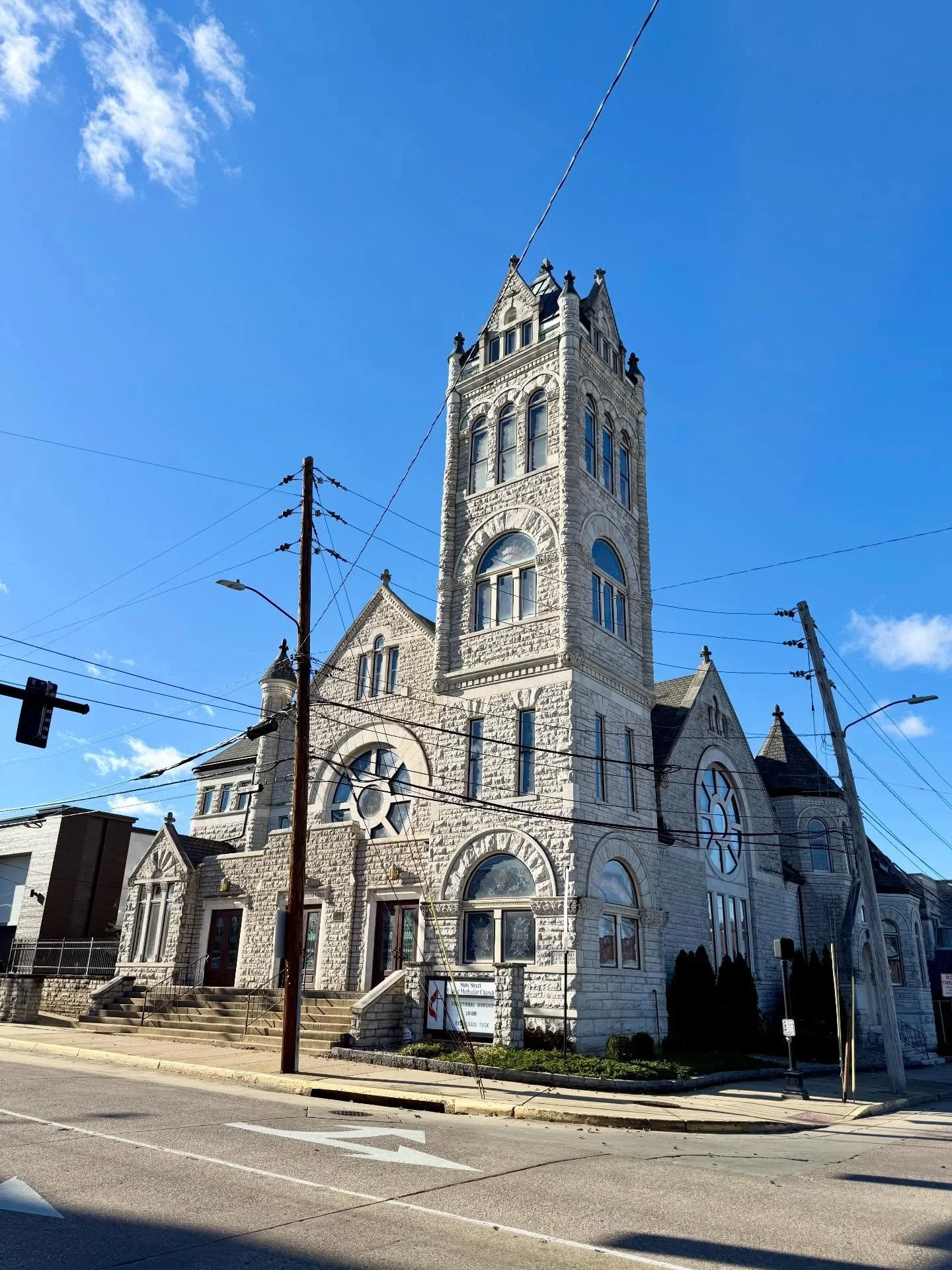
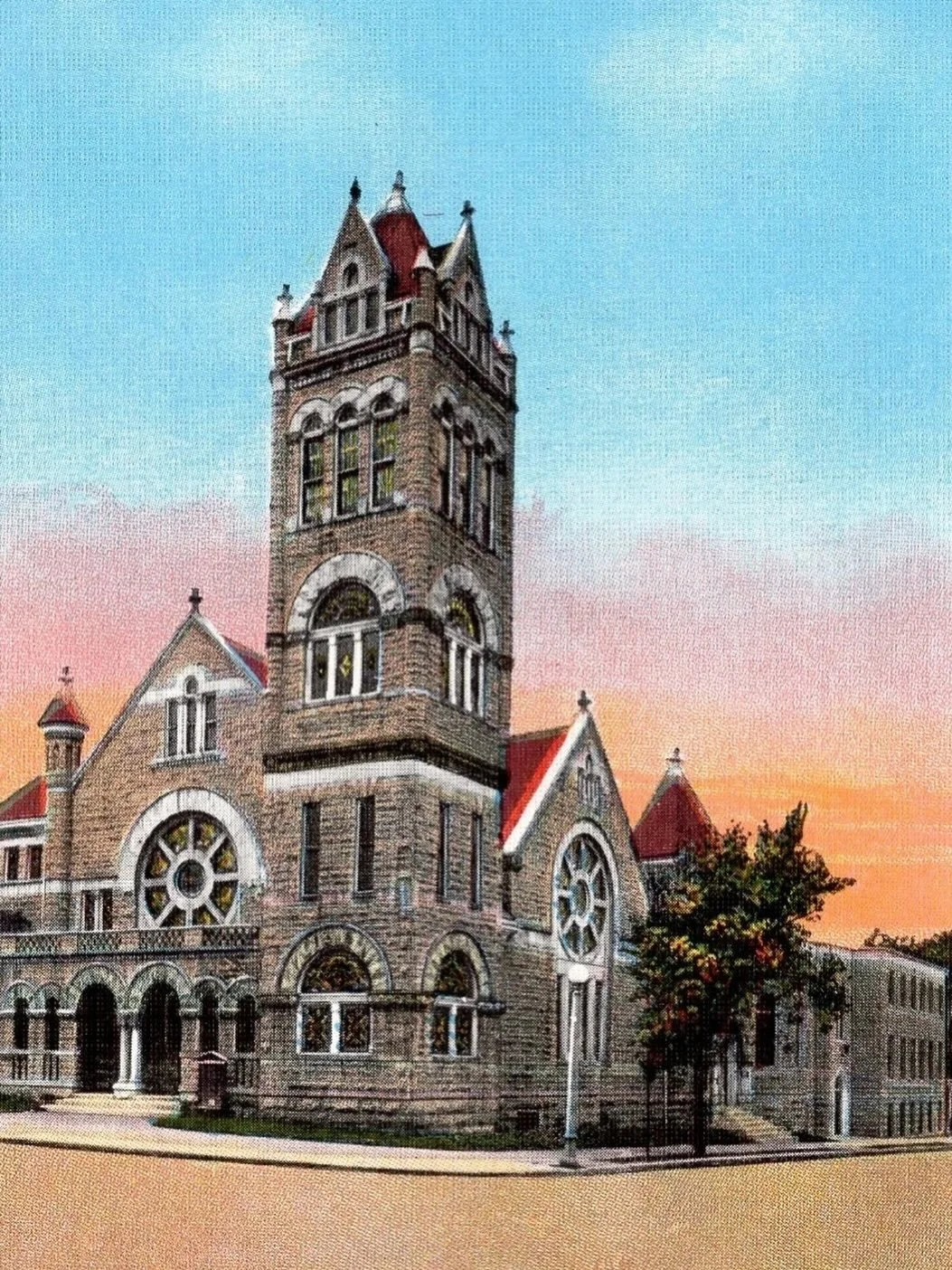
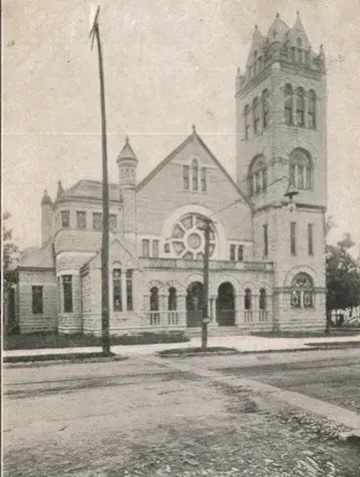
The third stop on this year’s Historic Holiday Tour is one of the most beautiful ecclesiastical buildings in town—the State Street United Methodist Church at 1101 State Street.
The congregation traces its roots to 1819, originally meeting at Benjamin Vance’s Tavern where the Pushin Building now stands. Over many years the Congregation expanded until the need for a grand structure was clearly established. Thus the current magnificent edifice was commissioned on June 18, 1895, for the whopping sum of $20,400.
Designed by Ruben H. Hunt of Chattanooga, Tennessee, and constructed entirely of our famous Warren County “White Stone,” the State Street United Methodist Church is a sight to behold. Romanesque in detail but uniquely American in design, many of the fine stained glass windows contain the names of the members and donors at the turn of the twentieth century.
We are beyond blessed with the opportunity to share this magnificent structure of supreme architectural interest. Please join us in thanking the congregation for sharing their spiritual “home for the holidays” with us and the entire community.
Kister House-Eloise B. Houchens Center
The fourth stop on this year’s Historic Holiday Tour is the stately Kister House-Eloise B. Houchens Center at 1115 Adams Street.
This classical revival house is the final vestige of old Adams—once the most prominent street in Bowling Green. Former houses sited alongside it included the Hines and General Blackburn mansions, the later of tremendous importance in the Civil War.
The Kisters were similarly prestigious. Frank L. Kister, Jr., rose from humble origins, being the son of a German immigrant, to become one of our most notable citizens at the turn of the last century. Indeed, he not only served as Mayor of the City of Bowling Green but also was responsible for the completion of Saint Joseph Catholic Church, modeled on the Cathedral of Cologne, Germany—and today one of our singularly magnificent local landmarks.
The Kister residence was commissioned and built in 1904, with the Kister family moving in January 1905. The house later passed through a series of hands before coming into the Eloise and Ervin Houchens family, who established the Eloise B. Houchens Center for Women in 1976.
Over the past five decades, the Houchens Center board and staff, along with the Houchens Foundation, have been responsible for the preservation of one of the finest buildings in Warren County. We are beyond honored to have the opportunity to help share this splendid structure with the entire community. Please join us in thanking all those involved in the preservation of this gorgeous place for sharing their “home for the holidays” with us.
Lindsey House
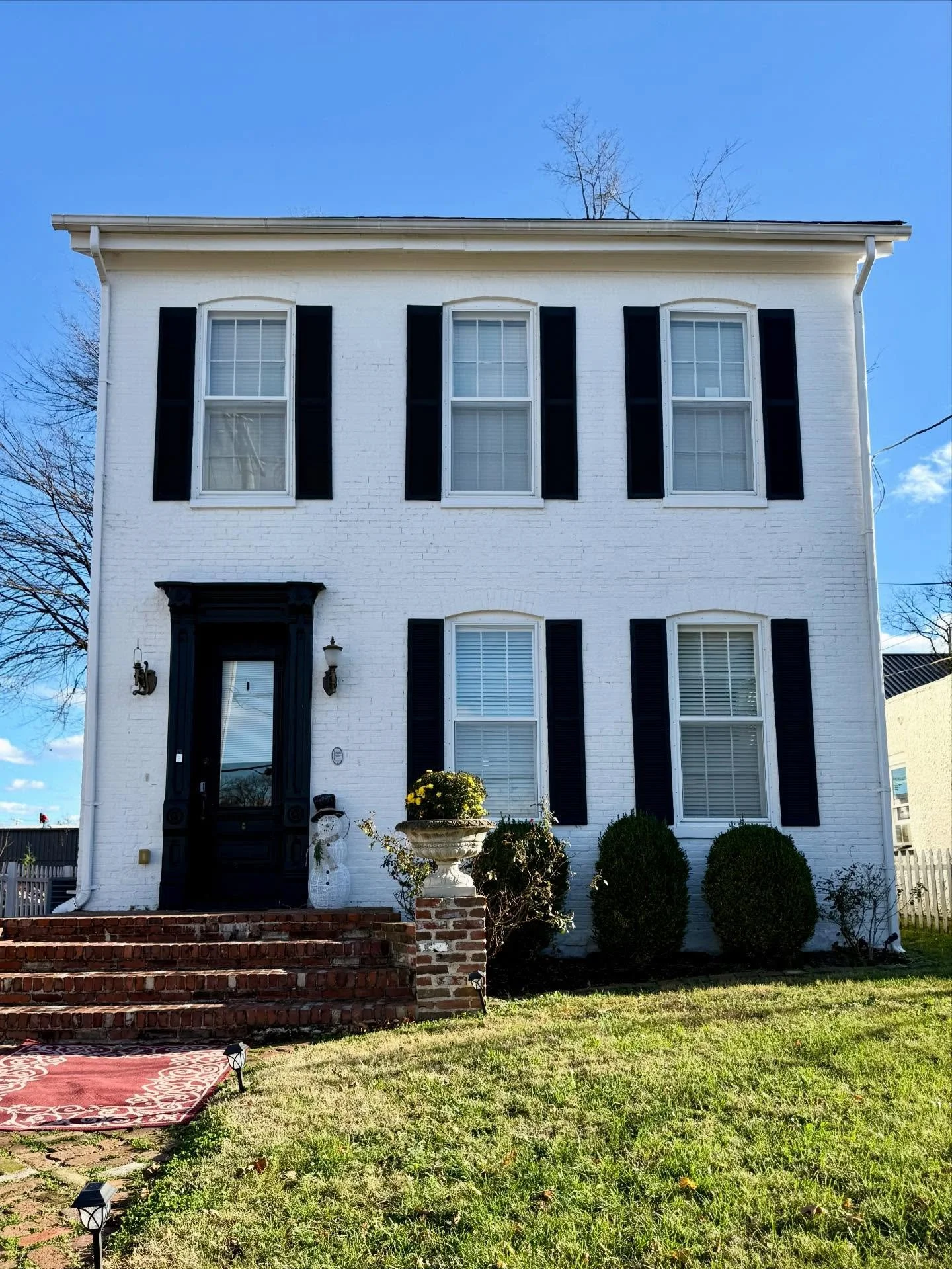
The fifth stop on this year’s Historic Holiday Tour is the classic Lindsey House located at 516 Chestnut Street.
This late Victorian house is somewhat of an enigma with a surprisingly murky history. Deed and Property Value Administrator records indicate the structure was built in 1938, but the style and construction of the house show this is wildly inaccurate—possibly off by as much as five decades.
Indeed, the Sanborn Map of 1925 shows the house in its current location and with its current floor plan, at least 13 years prior to the date indicated in county records. The style of construction is late Victorian in detail and finish—original sash windows and handmade elements are dead-giveaways of a nineteenth-century build date.
Regardless of the exact construction period, we are very lucky for the Lindsey family’s willingness to share the building. One of the last remnants of a once bustling neighborhood, this house and the others on its block are of paramount importance in telling the history of this area of our town.
We hope the Lindsey’s sharing their “home for the holidays” with us will help uncover a few more clues to the mysteries behind this beautiful structure.
George Washington Carver Center
The sixth stop on this year’s Historic Holiday Tour is the remarkable George Washington Carver Center located at 201 State Street.
Originally built in 1926 at Second and Center Streets, the George Washington Carver Center was a four room, single family dwelling constructed in a vernacular Victorian style. The building was moved to its current location in 1980 after the Center Street plot was purchased by the City of Bowling Green. The Carver Center is the only surviving original building from the block.
The historic significance of its current location at 201 State Street cannot be overstated. Indeed, the founder of Bowling Green, Robert Moore, gave the land on either side of State Street bordered by current 2nd Avenue, Max Hampton Street, Short Avenue, and the Kentucky Grapplers building to Black residents for use as a public square of their own. This plot was later named Lee Square, according to the 1877 D.G. Beers & Co. Map. Unfortunately, this transaction was never formally recorded.
The George Washington Carver Club was founded in 1946 by a group of Black business and professional women of the Shake Rag neighborhood. Founding officers included Ora Porter, the first registered nurse in Western Kentucky, and Delores Moses, who owned and operated the now-demolished Southern Queen Hotel.
Although it started as a social club, the women became concerned with the social, cultural, educational, and recreational needs of the local community. They thus sponsored after school activities including Girl and Boy Scout Troops and 4-H programs; they also taught sewing and etiquette to children, raised funds to support the local high school band, and awarded scholarships.
Today, the Carver Center continues to support the community with academic assistance, activities for seniors, and providing a meeting place for the public and family events. The Center is one of few remaining organizations original to the Shake Rag Historic District.
We feel deeply privileged to share the Carver Center’s “home for the holidays” with the community.